

Did you put up fairy lights, or even the tree, early this year? With millions feeling quite low from being furloughed, made redundant, taking pay cuts, or work burnout, the small things really do make a big difference. We have to do what we have to do to make ourselves feel better. But what could employers do to boost morale in the workplace?
Working from home this year, for most, means business leaders now know that we don’t need to be in the office to get things done. Employers have had no choice but to trust their people, which some would say has been an issue for a lot of leaders to date. It is a big change, but if objectives, clear responsibilities and regular reviews are taking place, it’s easy to see if they’re being met.
Keeping up morale however, especially remotely, is more difficult. Some managers are great at checking in with their team and keeping everyone motivated. Others aren’t as fortunate and might suffer from having less supportive managers. This is where the leadership team, HR and marketing can fill some voids, in terms of regular communication and employee engagement (but hopefully there is also a development plan and training in place for managers).
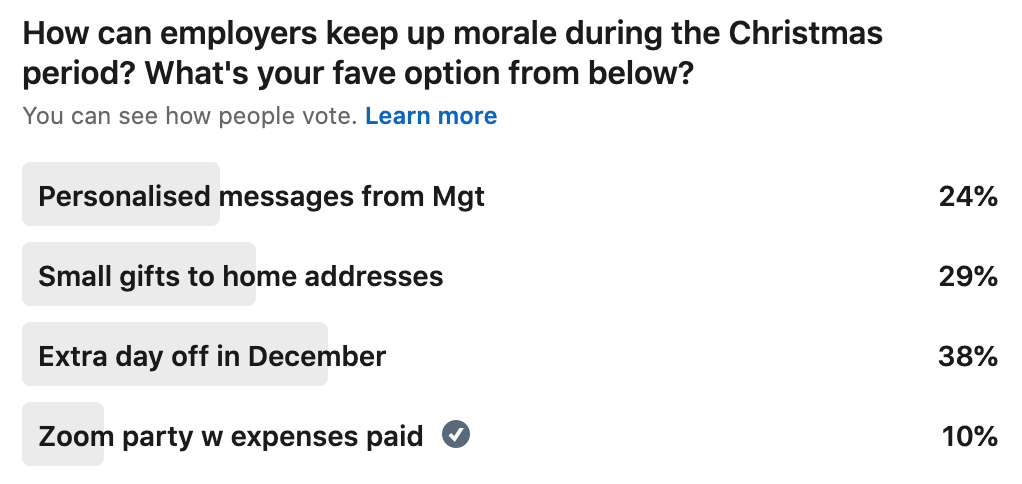
Now we’re in the silly season, people might be missing the usual office antics of decorating the office, having drinks at the local, secret santa, and of course, the office party. Not everyone has a “work husband” or “work wife” to rely on, and if you’ve recruited new staff this year, connecting with other workmates is much harder. So with many budgets frozen, or drastically reduced, how can employers keep up morale in December, and beyond? I asked my LinkedIn network to vote on this poll, with most wishing for an extra day off.
What other suggestions would you have? Please leave a comment at the bottom of this page.
LinkedIn Poll:
Keeping up morale and engagement
Short on time? In a nutshell, here is what employers could offer:
- Employee engagement surveys: be transparent with the data and act on the key areas
- Set objectives and Personal Development Plans (PDPs): everyone wins when the business and its people are on track with meeting business goals
- Book in and keep up regular 121s with everyone in your team: no matter how busy you are, make time or risk demotivation
- Have regular team check ins: a communicative team is a strong team
- Provide channels where people can create special interest groups: enabling people to connect across departments creates a better work culture
- Provide mental health benefits and/or communicate free resources: show empathy by providing benefits, or at least open conversations
- Provide flexible working options: avoid employee turnover by offering post-pandemic options, almost 90% want to continue with some sort of flexibility
1) Surveys
I love surveys! I’ve always been a fan of a good employee survey, but they can become tiresome pretty quickly if people don’t see results afterwards. When you have a medium or large sized business, it is the quickest, smoothest and most reliable way to get good data directly from employees. They can be anonymous but still give you key data (if the company is big enough) about office location and/or department sentiment, how well managers are perceived and even which employee level is happiest (from interns to senior management).
The key for a successful survey is to be transparent. Show the data and communicate what you plan to do to improve certain areas where feedback highlights a need, then most importantly, share the results! Be prepared to follow up once a survey is out, regardless of the survey data. Own it, work on it and keep at it.
Some companies, like Amazon and Facebook, use daily micro check ins’, others send out monthly or yearly surveys. Just remember to follow up in a timely manner to reassess the scores for the key points and see how you’ve progressed as a company. There are plenty of platforms out there to suit your needs, so work out what you need and shop around.
2) Objectives
For management: Objectives ensure people have direction and motivation to meet key goals, but surprisingly a lot of employees go through the working year without any objectives, or reviews. If a company doesn’t have a robust system in place it’s a major red flag to me, even for small companies. How else can leaders ensure their business is moving forwards towards the key business strategy and goals?
After objectives, usually comes personal development plans (PDPs), this is where people can assess where their strengths and weaknesses are in relation to fulfilling their role and exceed expectations. Giving people the tools and time to improve is extremely motivating and investing in people’s future has a huge return in investment, from improving overall culture, to decreasing employee turnover.
For employees: If you don’t have objectives in place, speak to your manager, or HR. Think of your career as your business; don’t rely on others to move yours forward, make sure you have some input in its direction too.
3) 121 time
For management: Make sure you make time for a 121 with each of your team. It could be once a week, fortnight or month, but do try your best to keep it in your diary and not rearrange. Your team wants that time with you and to feel you want that time with them. It reinforces your working relationship and brings the human into human resources and boosts motivation. One of the biggest complaints is not feeling appreciated, or having an outlet to give individual feedback. If you want to keep your team happy, make time for them and they will give you twice as much back.
For employees: If you’re not currently having 121s, reach out to your manager and work out what’s best. They’ll be happy to hear that you’re keen to improve and if you don’t feel comfortable approaching your manager for input, reach out to a trusted colleague or find yourself a mentor.

4) Team time
For management: Some managers will naturally spend more time with one or a few of their team e.g. on key projects, whilst the rest of the team might hardly hear from their manager week on week. This is to be expected, but, as well as having some 121 time, bringing the team together for regular team catch ups, even if there isn’t much to add since the last catch up, is important for team morale, especially whilst remote working.
“The most important factor in work happiness, a UK study showed, is positive social relationships with coworkers. Workplace engagement is associated with positive social relations that involve feeling valued, supported, respected, and secure.” – HBR
For employees: If your manager keeps missing the team check ins or fails to put them in the diary regularly, have them anyway. Try a Friday team call, chat about your weeks, or just check in and talk about your weekend plans.
Bottom line: We’re humans, we need to feel connected.
5) Be silly, sometimes
For management: “All work and no play makes Jack a dull boy” – old proverb. It is possible to inject some fun into the workplace to motivate, engage and improve the work culture (and yes still get the work done!).
If you have a good intranet, create groups for people to join, have an online games section, or a fun YouTube video wall for break times. Using an instant messenger platform? Set up a channel just for random posts, GIFs or something else not necessarily work related. The possibilities are endless! Think football enthusiasts, running clubs (we all know how runners love to share their times!), music lovers etc. This may help strengthen cross-department/office relationships and create new connections. Management can still keep it all business-friendly by implementing, or adding to, your internal communications policies.
For employees: It doesn’t have to be left up to management, HR or comms to implement new ideas, speak to them yourself, or create a group, or event. Sometimes, once management sees an active interest from employees for something, it can become official.

6) Flexible working
This year has meant most of us office workers have been working from home, but this increasingly preferred way of working was on the rise before C-19 was here. Research in the US suggests that those working from home grew by 159% between 2015 and 2017. An increase in freelancers and new technologies has helped with this transition, but it is also seen as a key benefit for those wanting a more flexible job and better work/life balance. A recent PwC survey indicates that almost 90% of employees will want to continue with some form of flexible working post-pandemic.
So, if employers want to keep up morale and avoid a spike in employee turnover once the job market is back on track, they must seriously think about offering flexible working, or risk losing people and find it harder to recruit.
7) Provide mental health benefits
With data reporting a 300% increase in people across the UK suffering from anxiety or depression during lockdown this year, it’s a stat that’s hard to ignore. Working remotely means feeling more alone than ever for some, and can also make it easier to slip into different habits or mindsets. Being overworked, or feeling unfulfilled at work also affects mental health and can lead to burnout.
“The link to loneliness suggests that greater human connection at work may also be key to solving the burnout problem.” – HBR
Providing a service for people to reach out to a professional anonymously is one of the best benefits employers could provide right now. Even if finance is set against the additional spend, who could argue with these stats:
Burnout at work can contribute towards:
- almost 37% higher absenteeism
- 49% more accidents
- 16% lower profitability
- 65% lower share price over time
“Recent studies estimate that loneliness costs employers in the UK billions each year and employee burnout costs the U.S. healthcare system hundreds of billions of dollars each year.” – HBR
If offering this benefit is absolutely impossible right now, management can still share the many free resources available through a newsletter, intranet or email. And for those who could do with some help right now, please click here.
Finally, I couldn’t end this blog post about employee morale without a quote from Vineet Nayar, author or ‘Employees First, Customers Second’, which is simply that!
‘Employees First, Customers Second’ – Vineet Nayar
In his 2014 Forbes interview he explains: ‘by employees first you can actually deliver your promise of customers first. If you do not put the employee first – if the business of management and managers is not to put employees first – there is no way you can put the customer first.’ Which makes perfect sense to me, how about you?
Work Perk Ideas:
Little things make a big difference, Consider the following when reviewing how to boost morale in the workplace:
- Bring back summer hours, for winter! Some companies finish early on Fridays during summer. Some would say we need this more in Winter!
- Duvet days: Offer duvet days when you know someone has gone above and beyond. They can use it when they really need to just stay in bed (the day would be at their manager’s discretion, obviously)
- Staff recognition: Some intranet platforms include built in apps where people can give thanks to each other publicly. Or include a shout out section in your staff newsletter.
- Employee Assistance Programme: A useful service for employees to use, including: online medical service, therapy sessions, discounts, freebies, feedback portals and recognition.
- In-house events: From wine tasting to learning a new skills. Development doesn’t have to be work-focused.
- Free fruit: Not everyone wants free hobnobs, offer a range of snacks to suit everyone’s needs (and hopefully help give people a vitamin boost!). In lieu of being in the office to receive the fruit, perhaps send out vouchers.
- Paid volunteer time: Give back to the local community through volunteering days. The nicest way to boost morale, self-worth and make a real difference.
- Learning grants: People submit what they’d really like to learn and why, from photography to Yoga courses and a panel chooses a winner each quarter, or whatever works best. Costs could be recouped should a winner leave the company within a certain timeframe.

Resources:
- Why Office Morale Will Be Hard This Year – The Economist
- Boost Employee Morale – Connect
- Maintaining Staff Morale, Especially Remotely – Perkbox
- Furloughed Workers Doubles – The Guardian
- Depression Tripled During Lockdown – Sheffield University
- Mental Health Helplines – NHS
- Home Working Here To Stay – BBC
- Burnout At Work Is Also About Loneliness – HBR
- What The Work From Home Boom Means – Entrepreneur
- Employees First, Customers Second, Why This Really Works – Forbes
Join The Conversation
Tell us about what your company provides, or what you’d like to have.
Thanks for reading!