

Take a deep breath and answer this honestly – how are you? Acknowledging this truthfully is the first step. We can be so occupied with, well, literally anything else, that we sweep how we’re really feeling to the side. This not only affects our own mental health, but of those around us too. How can we self-reflect more regularly and help put ourselves in the best position to deal with what the world, and our minds, have in store for us? First, I’ll ask you again, how are you, really?
Let’s look at stress. There seems to be an endless supply of things trying to meddle with our stress levels. But what is stress? You might be surprised to know that there isn’t a medical definition for stress, but plenty of possible causes, and sometimes it can be difficult to determine, or even be aware of, what is contributing to our own personal stress.
A little bit of stress can be motivating, but it’s important to know when it has become more. There can be physical, mental and/or behavioural symptoms, from headaches and stomach problems, to forgetfulness and sleeping too much, or too little. Most of us experience minor and major stress throughout our lives, and some more than others. Sometimes, especially with typical daily stresses, we just accept that’s how it is and get on with our days, then wonder why we feel burnt out.
“In 2019/20, stress, depression and anxiety accounted for around 55% of all work-related sick days.” – HSE
Managing Stress
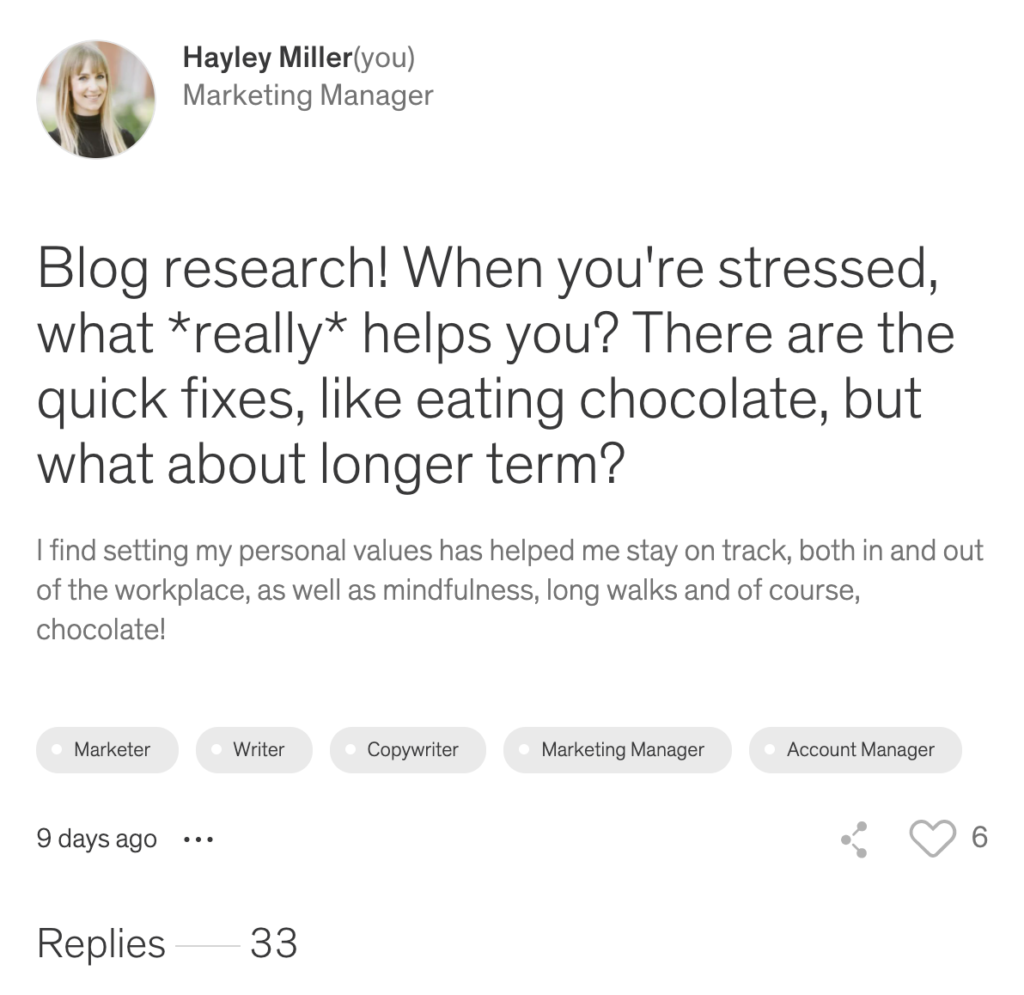
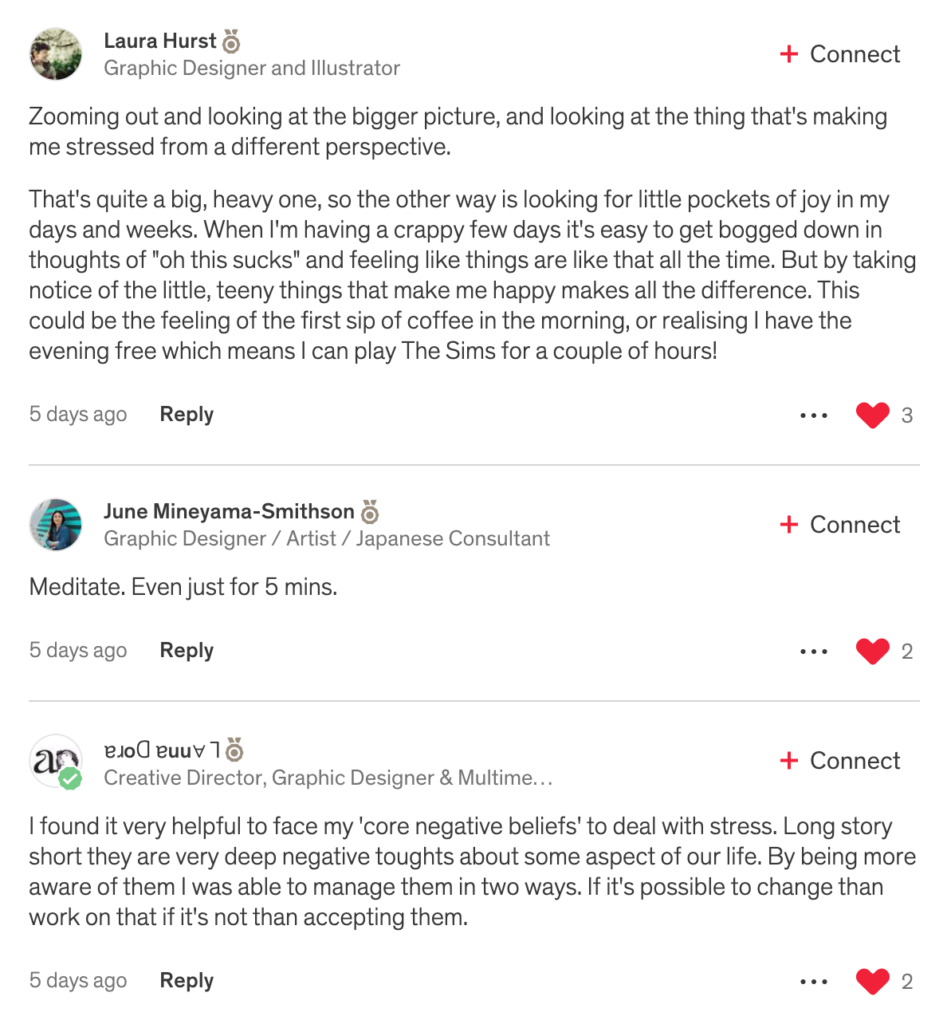
The NHS has great resources for managing stress, including a mood self-assessment quiz and tips to reduce stress (see links in the resources section). I recently asked my network on LinkedIn and The Dots, as well as some friends, for their top go-to method when feeling stressed, especially whilst at work.
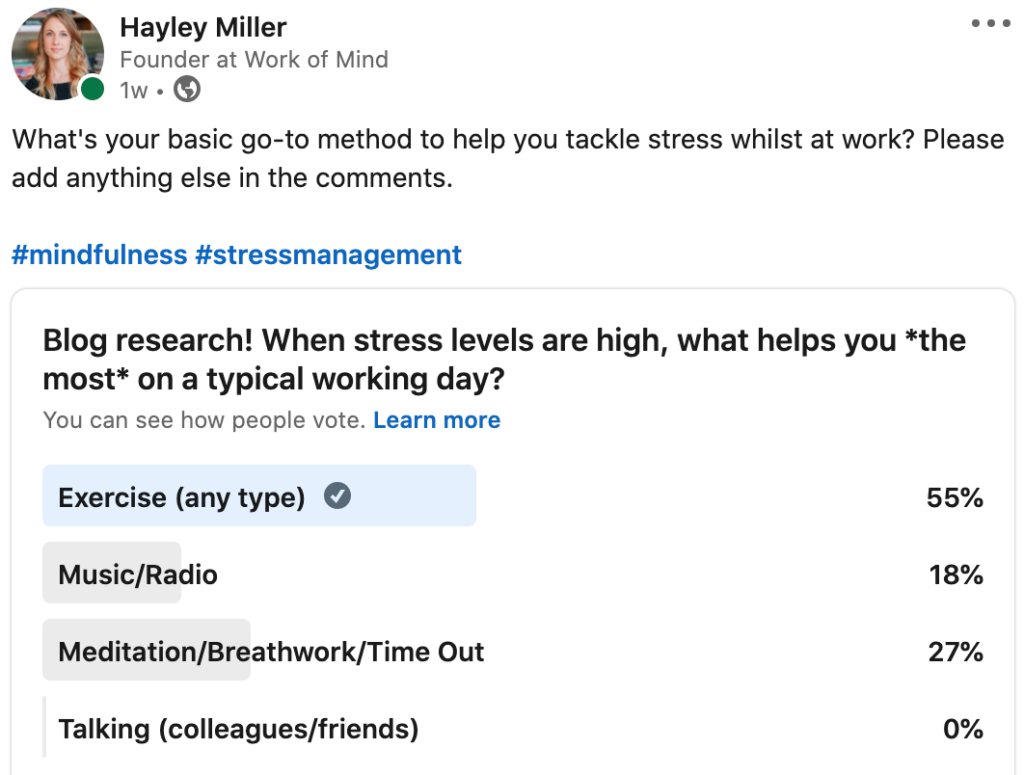
The most popular answer was exercise, and the effects of exercise has been widely discussed for some time, with key benefits including a boost in serotonin, increased energy and improved health.
Others included listening to music and meditation, but I was surprised that no-one said ‘talking’. A problem shared is a problem halved, as the saying goes, so why is talking still low on the agenda when it comes to our mental health? Typical reasons include:
- Shame
- The stigma that is sadly still attached to mental health problems
- Feelings of being ‘weak’
- For men especially, feeling they should ‘man up’ and be able to cope
- Fear of having to talk about something so painful
- Fear of a disappointing response from someone close
- Feeling it won’t make a difference
- Not wanting to inflict problems onto others
The world is seemingly crazier than ever; we have more distractions, and are more connected than ever, but we’re also less connected in many ways, especially with our own emotions. It’s all quite exhausting, but sometimes we don’t realise just how exhausting until something snaps and it all becomes too much.
Talking is one of the best ways to reduce stress and there’s a multitude of studies as to the reasons why. Here are a few:
- Strengthens our immune systems (bottling up our emotions can contribute to illnesses)
- Reduces physical symptoms like headaches and muscle tension
- Helps us concentrate more and worry less
- Reduces anxiety and improves sleep
Performance Managing Out Stress
I cringe slightly at what I’m about to write, but perhaps we could try looking at our lives as we would a business strategy. I’m a huge advocate for defining values, in and out of the workplace. Values in the business sense help companies stay on track, they typically remain unchanged, even if the business goals do change. They are the core beliefs and behaviors that help guide its people towards a purpose. These can be good for individuals too and can help us move away from things that don’t add value and move towards the things that do.

Task: Values
I’ve written about values in my other blog post ‘Finding Your Buzz: What Makes You Happy’, but let’s delve deeper into how it can help us feel more connected to ourselves.
- Grab a pen and paper, open notes, Google Doc or email, whatever works, and write down your top 5 descriptors when describing yourself; I’m talking about your core values, for example, perhaps honesty, loyalty and/or being a good listener is of utmost importance to you and how you want people to see you.
- Write down values you look for in a partner or friends, they might even be the same values as your own.
- Write what you’d like to continue to do throughout your life, what’s most important to you, from your career, to interesting activities.
- Finally, write down your biggest aspiration.

Back to Business
I realise how rigid it sounds to use work methodologies for our personal lives, but it’s helped me so I hope it does the same for you. If you’ve ever been in a role or company that has been very reactive, hectic and stifled by red tape, then been somewhere that has a clear strategy and great tools and resources, you’ll probably recognise why planning is key to success (and keeping your sanity!).
Ideally we’d be prepared for, and aware of, stress creeping in before it overwhelms us, so let’s use another key business tool – the strategy house. If you prefer a nice visual over information overload, then this is for you.
Strategy House
Create your strategy house by completing the following:
- Vision: what you are working towards – an end goal
- Mission: what you’re going to do to get you there
- Values: the golden thread that links everything together – your non-negotiables: behaviours and beliefs that are important to you
- Pillars/Goals: a few key goals that will help you get to your vision (and then list the activities required under each)
I’ve added some examples below, to give more of an idea:
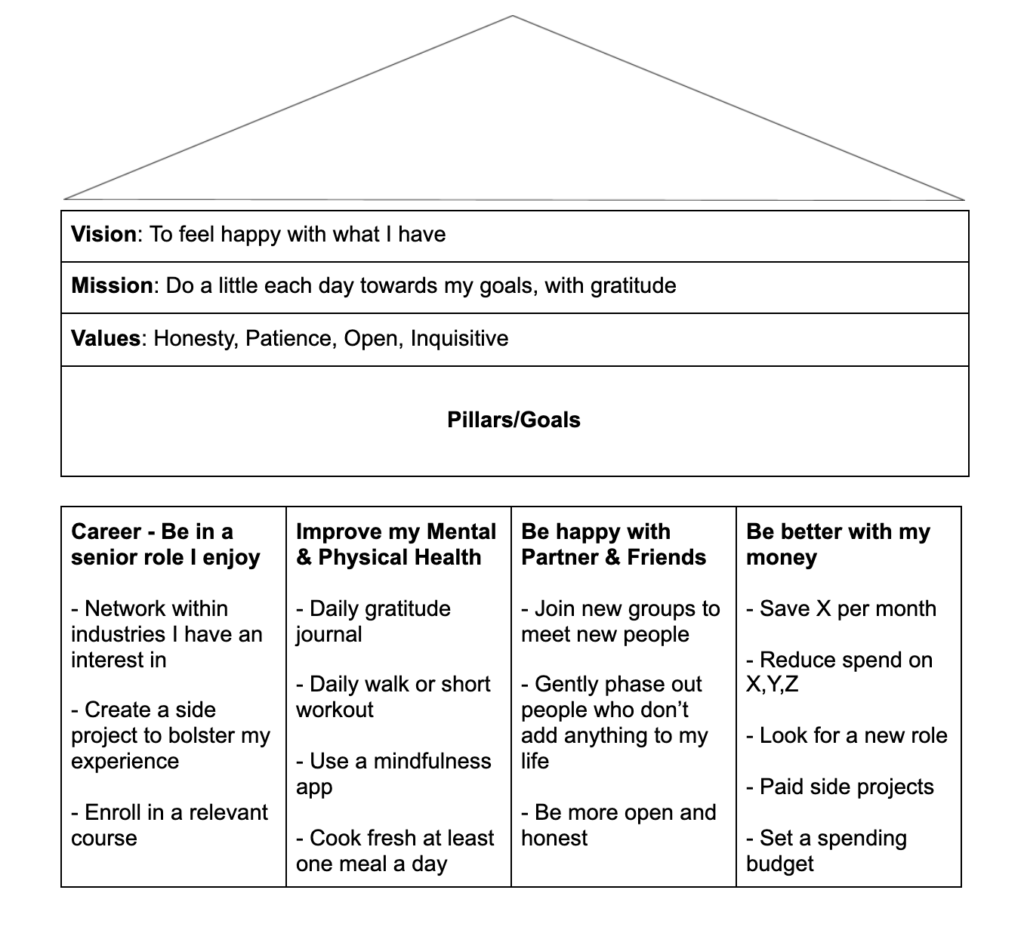
How does it feel to see your vision and goals in black and white? Most of it has probably been in your mind for some time, but hopefully seeing it in this format gives the feeling of a stronger purpose and renewed motivation. There doesn’t need to be set time limits against each goal, unless you do have time-specific goals, but ideally it’s something to refer back to as and when, to keep us nicely focused throughout the year.
Planning for Peace of Mind
The key idea is that having a plan, of sorts, helps alleviate the pressure of having to feel like we’ve got our shit together. We have a plan, some goals will be worked on now, and some later. Sometimes just having a plan written down, however loose, gives us an assurance that we’re heading up the right path and we’ll deal with everything else as it comes (whether that’s with the help of eating copious amounts of chocolate, or going for a run).
Check-ins
Finally, I wanted to mention that I saw this post by the great research professor, Brené Brown, and it makes total sense that, yes, let’s be self-sufficient and dedicate time to self care BUT let’s also look out for the people around us.
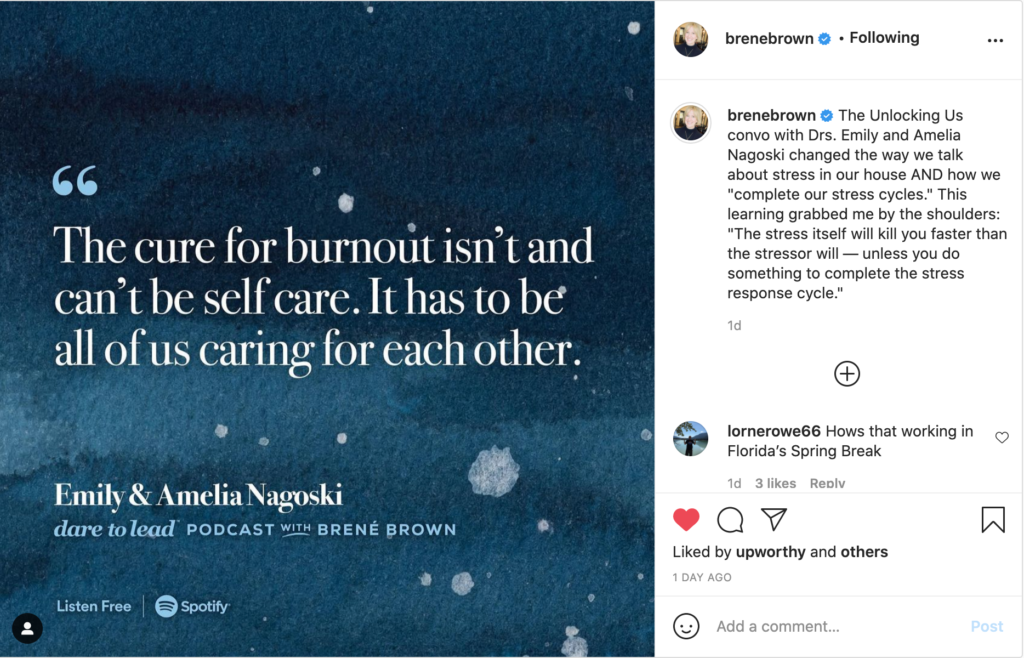
Encourage conversations and check in with those you haven’t had a proper catch up with in a while. And if you’re an employer reading this, please ensure you have decent benefits and processes to help your people, your business depends on it! With Stress Awareness Month happening in April, it’s a great time to start talking about it.
Let’s help ourselves by also helping others.
Facts About Stress:
- Low productivity and sickness caused by stress, and other mental health problems, costs businesses billions each year (Centre for Mental Health)
- In 2019/20, stress, depression and anxiety accounted for around 55% of all work-related sick days (HSE)
- Office politics, lack of internal communications and colleagues’ work performance topped the 2020 stress survey (Perkbox)
- 25-34 year olds are shown to suffer most from stress (Perkbox)
- Feeling lonely is mostly associated with reports of high anxiety levels (ONS)
- 1 in 5 reported high anxiety levels from difficulties working from home (ONS)
Resources:
- What is stress? Mind.org
- Mood test – NHS
- Mind Plan Quiz – NHS
- Mental health problems at work costs billions – Centre for Mental Health
- Stress stats – HSE
- Workplace stress survey – Perkbox
- Stats on mental health during Coronavirus – Forbes
- Coronavirus and anxiety in Great Britain – ONS
- Talking about mental health – Huffington Post
Stress Helplines & Tools:
- Please call your GP, or 111 for non-urgent advice
- Samaritans
- Mind
- No Panic
- School of Life TV
- NHS: Mental Health support
- App: Headspace
- App: Calm
Join The Conversation
What has helped you the most? Are you struggling now? Was this article helpful?
Thanks for reading!